GUPPI
Ask your rig a question and get an answer from its live state: “How’s guiding?” is answered from the guider’s actual RMS right now, not from a canned response or a cloud service. GUPPI (Ground Unit Primary Peripheral Interface) is the rig’s onboard intelligence. It is one product with two power levels: a built-in brain that runs on the rig itself, and a way in for an agent you already use. One safety model governs both.
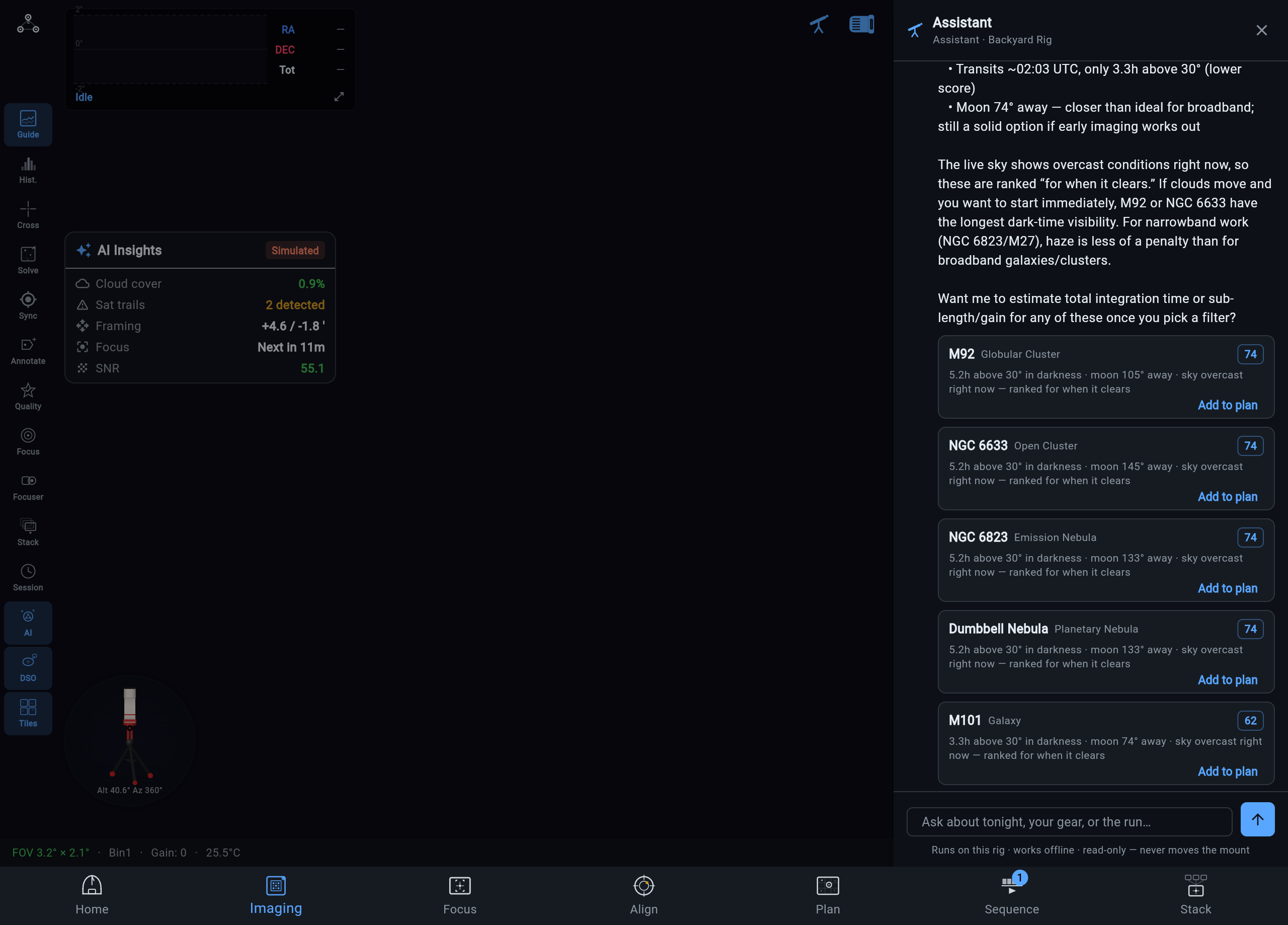
Open it from the telescope glyph in the app header. On desktop it is a side panel; on a phone it is a bottom sheet. It is always titled with the rig’s name, because every conversation is grounded in one rig’s live state.
GUPPI, out of the box
Section titled “GUPPI, out of the box”The built-in brain runs entirely on the rig. A Raspberry Pi answers the core questions deterministically: no model on board, so answers are instant and every number comes straight from the rig’s own tools. On a Jetson, GUPPI runs a full local model. The model steps aside while the rig images: whenever a sequence, an exposure, autofocus, polar alignment or stacking runs, the rig unloads it so capture keeps the memory, and GUPPI answers the way a Pi does until about two minutes after imaging stops, and says so. Either way it is private by design: your questions and images never leave home, and it works with no internet.
What you can ask
Section titled “What you can ask”The built-in brain reads live telemetry through a fixed set of rig tools:
- Guiding: current RMS, guide star health, and whether that wobble is seeing or something worth fixing.
- Sequence progress: what is running, frames completed, and the ETA.
- Conditions: tonight’s forecast and the golden windows worth imaging (see Weather Intelligence).
- Sky state: what the all-sky camera reads right now, if you have one set up (see SkyNode).
- Last night: “What happened last night?” reads the Guardian night journal and gives you the postmortem: what completed, what held, what recovered on its own.
- Targets: “What should I shoot tonight?” returns recommendations scored for your camera, optics and site, not a generic top-ten list. Each suggestion carries a one-tap Add to Plan that drops the target straight into a Plan draft for review.
Answers show their work. The panel displays which rig tools were consulted for each reply, and when GUPPI explains a concept (what a good RMS looks like, why stars bloat in poor seeing) it cites a curated astrophotography knowledge base rather than improvising.
When it doesn’t have data, it says so. A rig with no forecast source gets an honest “I can’t see a forecast,” not an invented one. And the built-in brain only talks astronomy: off-topic questions are declined before they ever reach the model.
Private by design
Section titled “Private by design”- The brain runs on your rig computer. Your questions, the answers, and every piece of telemetry they touch stay on your network. Nothing is sent to a cloud service, and nothing is used for training.
- It works offline. At a dark site with no internet, everything grounded in rig state still answers: guiding, sequence, journal, targets. Only internet-backed data such as the weather forecast degrades, and GUPPI tells you when that happens.
- It never touches your images. The built-in brain reads telemetry and status, not your data files.
GUPPI + your own agent
Section titled “GUPPI + your own agent”The built-in brain is the out-of-the-box power level, not the ceiling. Every ARIS rig serves GUPPI over MCP (Model Context Protocol), the open standard AI agents use to reach tools, so an agent you already run can work the rig with you: Claude, ChatGPT, or anything else that speaks MCP, down to a local model on your own machine.
There are two ways in:
- On your network. Claude Code, LM Studio and any MCP client that speaks Streamable HTTP reach the rig directly, with a pairing key you make in the app. See Pairing an agent.
- Through the ARIS relay. Claude (web, desktop and phone) and ChatGPT cannot reach your network, so they reach your rigs through the relay at
mcp.arisastro.comand sign in with your ARIS account. See Claude and ChatGPT.
A connected agent reads the same live rig the built-in brain does: status, guiding, the sequence, the night journal, the latest frame as an image, tonight’s visibility of any target, and the saved sequences in your Library. Its trust level decides whether it may also act: run autofocus, change filters, build a sequence and save it to your Library, load a saved sequence onto the Sequencing screen, pause or stop a sequence, and move the mount (slew to a target, home, park, unpark, start a saved sequence or the one on the Sequencing screen, resume a sequence).
Every agent is told how to work the rig well when it connects: the GUPPI Operator guide, which Claude users can also install as a skill.
One honest note: the privacy guarantees above describe the built-in brain. Plug in a cloud agent and what it reads travels to that agent’s service, on that service’s terms, a trade you make per agent and never by default. With Claude or ChatGPT, the calls also pass through the ARIS relay and your rig’s secure connection to the ARIS cloud on the way.
One trust dial for every brain
Section titled “One trust dial for every brain”Every agent connected to a rig has its own trust dial, and the dial decides what it may do:
- Watch only: read the rig and answer questions. Nothing else.
- Ask before motion: also run autofocus, change filters, save sequences to your Library and load them onto the Sequencing screen, and pause or stop a sequence. Anything that moves the mount waits for your approval.
- Full autopilot: also move the mount without asking. The rig tells you what it did.
Every agent starts at Watch only. You set each agent’s level on its page in Settings → GUPPI, and you can switch off its autofocus, filter or sequence tools there one group at a time.
At Ask before motion, a request to move the mount reaches you as a card in the app and, on an iPhone or iPad, a notification you can answer from the lock screen. It expires after 10 minutes, and approving it runs every one of the rig’s checks again at that moment. No agent can answer a request, its own included: you approve or deny it in the ARIS app. Every write an agent makes, every write it is refused, and every motion request with its answer goes into the rig’s night journal.
The built-in brain has the same dial, in Settings → Guardian & Automation, and it ships at Watch only too. Its actions are Guardian’s playbooks: at Ask before motion it runs each one as you set it, except that the three that move the mount ask you first.
Wherever a dial sits, Guardian’s hard limits stay on. Every action any agent takes goes through the same interlocked, safety-checked rig operations you would trigger yourself, and no level gives an agent raw axis moves, a sync, a pulse guide, a tracking rate, a site or time change, or a firmware, driver or limit setting. An agent chooses actions by name and can say why; it never composes device commands.
The details are in The trust dial and approvals.
NINA rigs
Section titled “NINA rigs”On a NINA rig, GUPPI runs in the ARIS backend that the plug-in starts beside NINA on the same PC. The plug-in download does not include that backend yet; see NINA Integration. Where the backend runs with a current plug-in, a connected agent gets the same trust dial, tool switches and approvals as on any rig, and its actions go through NINA. With an older plug-in GUPPI only reads there, and the agent’s page says so. The built-in brain’s playbooks are not on NINA rigs yet.
Availability
Section titled “Availability”GUPPI is included with paid ARIS plans, Hobbyist and up.
It is in early access. Expect it to keep getting smarter, and occasionally to be wrong. The grounding in live telemetry and visible tool calls exists exactly so you can check its work.