Overnight Deep Stacking
Deep stacking is the quality pass. While live stacking shows you the night as it happens, the deep stack runs after the night is over: the rig re-registers and re-integrates every light frame from scratch with Siril and writes an archival master — so the first thing you see in the morning is a finished stack, not a folder of subs.
There is nothing to configure and nothing to click. Finish a sequence, go to bed, wake up to a master.
When it runs
Section titled “When it runs”The deep stack triggers automatically when a sequence completes — or when you stop it — with at least 10 light frames for a target. Stopping a run early doesn’t forfeit the stack; if the night produced enough subs, they get integrated.
Everything runs headless on the rig itself. Your laptop can be asleep, the app can be closed, the phone can be in another country.
What it does
Section titled “What it does”For each target and filter from the night, the rig drives Siril through a full re-stack:
- Registers every light frame from scratch — a fresh global alignment, not the incremental fit the live stacker uses.
- Integrates with outlier rejection — statistical rejection scrubs satellite trails, aircraft, cosmic-ray hits, and hot pixels out of the master, with normalization across frames.
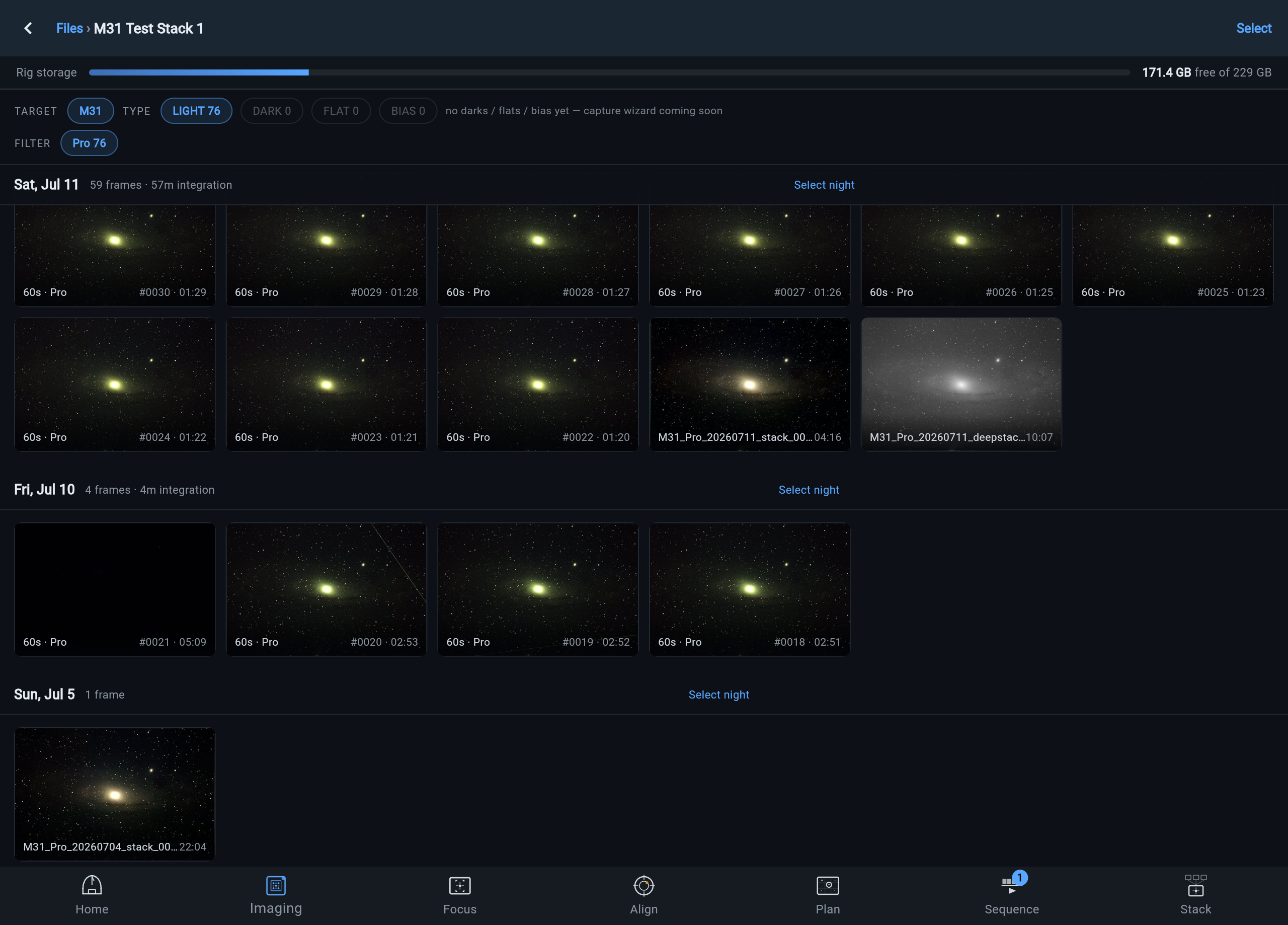
- Writes two outputs: the archival master FITS (your data, full depth, ready for post-processing) and a stretched JPEG preview you can judge from your phone.
When it finishes, paired rigs push a “Deep stack ready” notification to your phone — tap it in the morning and the JPEG tells you whether the night was worth getting out of bed for.
Where the outputs land
Section titled “Where the outputs land”Masters are written into the same Files tree as your subs, next to the frames they came from:
<Project>/<Target>/LIGHT/<Filter>/ <target>_<filter>_<night>_deepstack_<N>subs.fits <target>_<filter>_<night>_deepstack_<N>subs.jpgOne master per target and filter, stamped with the night and the number of integrated subs. They appear automatically in the Files browser and gallery — no import step. Prior stack outputs are excluded from future re-stacks, so a master never contaminates the next night’s integration.
How long it takes
Section titled “How long it takes”Minutes, not hours. A full night of subs re-stacks in about 15 minutes on a Raspberry Pi 5 — the stack is typically waiting for you long before dawn, let alone breakfast.
If no stack appears
Section titled “If no stack appears”- Fewer than 10 subs — short runs don’t trigger a re-stack. The subs are still in Files; stack them by hand downstream if the target is worth it.
- Look in Files first — outputs land next to the night’s subs at the path above, not in a separate stacks area.
- Siril not found — the rig installer includes Siril, so this normally can’t happen; if the deep stacker reports Siril missing after a manual OS change, reinstall Siril on the rig.
Deep stack vs. live stack
Section titled “Deep stack vs. live stack”| Live stack | Deep stack | |
|---|---|---|
| When | While you shoot | After the sequence ends |
| Purpose | Instant view of the night | Archival quality pass |
| Method | Incremental align + sigma-clip per sub | Full re-registration + rejection integration (Siril) |
| Output | Night-scoped FITS, updated live | Master FITS + stretched JPEG |
The two are complementary: arm the live stack to watch the target build, and let the deep stack hand you the better version in the morning.