Rotator & Framing
With a rotator, framing is a number: the position angle of your sensor against the sky. ARIS treats it that way — ask for a sky angle and the rig closes the loop until you have it, instead of leaving you to translate mechanical rotator degrees into sky orientation by hand.
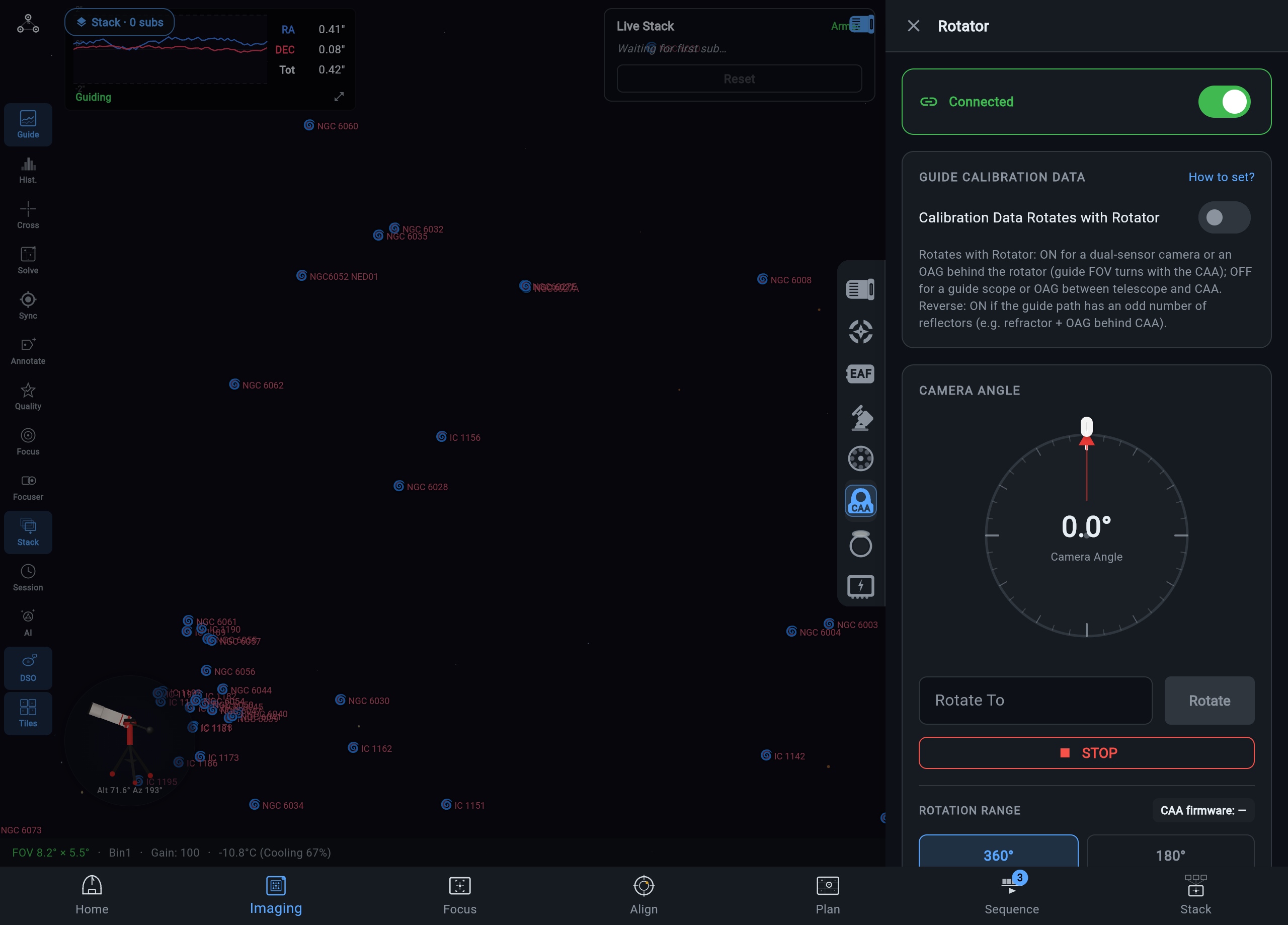
Dial in a position angle
Section titled “Dial in a position angle”Ask for the sky position angle you want — from the Plan screen’s field-of-view framing or directly on the rotator screen — and ARIS runs the loop: plate-solve to measure the current angle, rotate, solve again, and converge until the frame is within 0.25 degrees of your request.
That precision is what makes planned compositions real. The frame you rotated around a target on the Plan screen is the frame the camera shoots, and a mosaic pane’s position angle (for example, from a Telescopius import) is honored as designed.
Calibration
Section titled “Calibration”A rotator reports mechanical degrees; the sky cares about position angle. Calibration links the two, and ARIS makes it one tap: Set as 0°, or sync the offset directly from a plate solve.
Two safeguards keep calibration trustworthy:
- Audited offset writes — every change to the calibration offset is logged: what changed, from what, and why. If framing ever looks wrong, the history tells you what happened instead of leaving you to guess.
- Pole guard — position angle from a plate solve becomes unreliable very close to the celestial pole, so ARIS refuses to calibrate from solves taken there rather than silently accepting a bad offset.
Cable-wrap protection
Section titled “Cable-wrap protection”Rotators drag cables, and cables have limits. ARIS tracks cumulative rotation and enforces your configured limits on every rotation command. When a requested angle would wind past a limit, ARIS unwinds via waypoints — stepping the long way around — rather than driving your loom to the stop.
Set the limits once for your cable arrangement in the rotator settings, and every rotation — manual, planned, or in-sequence — respects them.
Rotation in sequences
Section titled “Rotation in sequences”Sequences keep framing without your involvement:
- At target start, the runner re-frames rotation automatically — each target in a multi-target night begins at its planned position angle.
- Through meridian flips, the runner is designed to hold your framing. A flip rotates the field by 180 degrees, and since a sensor’s framing repeats every 180 degrees, holding composition after a flip takes a small trim rather than a half-turn. ARIS accounts for this so the post-flip frame lines up with the pre-flip stack.