Weather Intelligence
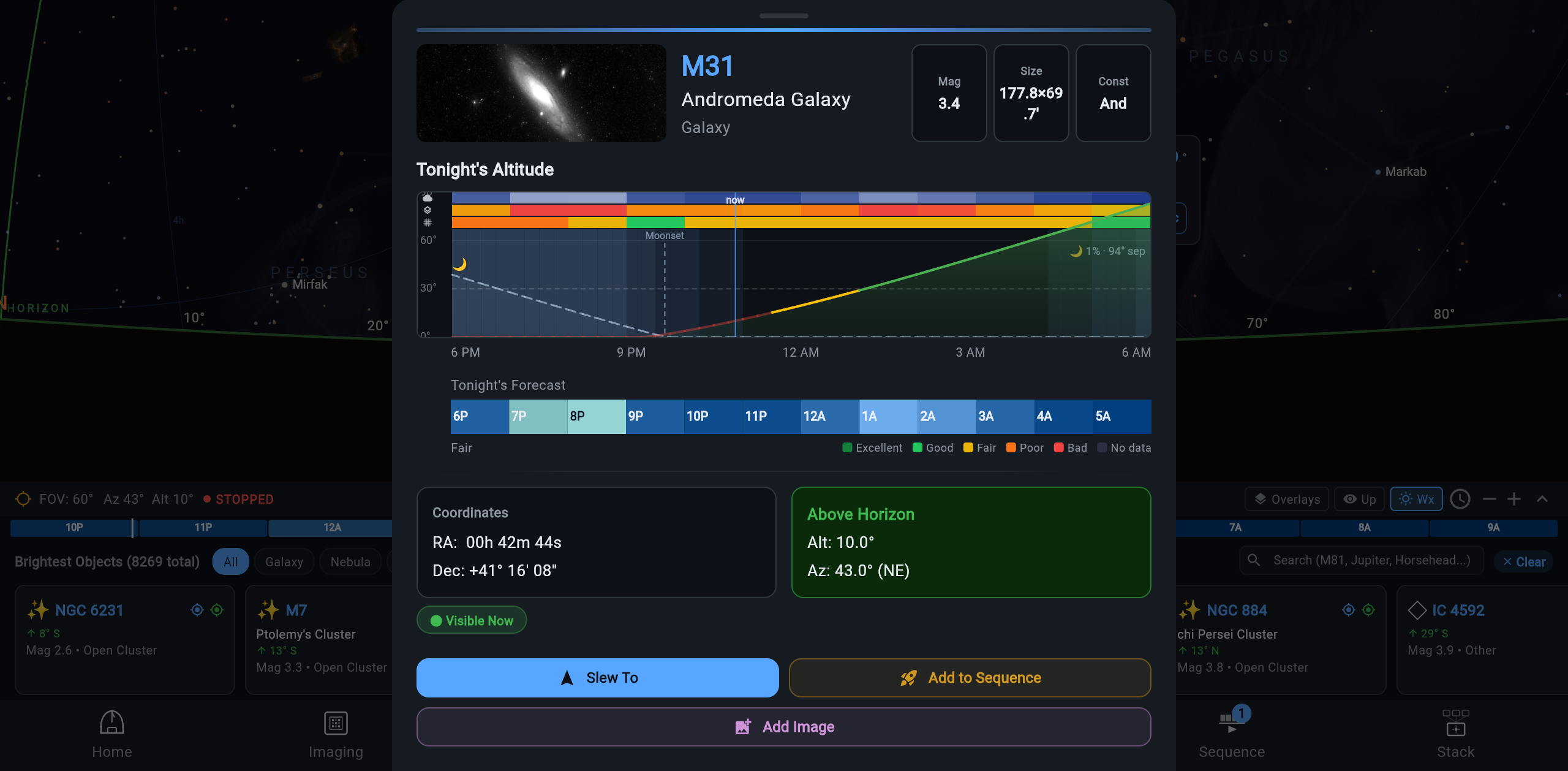
The dashboard carries an hour-by-hour forecast strip built for imaging decisions: cloud cover, seeing, and transparency for the night ahead, with the hours worth imaging highlighted. It answers “is tonight worth setting up?” at a glance, from any device connected to the rig.
Enabling the forecast
Section titled “Enabling the forecast”The strip is powered by your own Astrospheric account:
- You need an Astrospheric Professional membership — forecast API access is a Pro feature on their side.
- Copy your API key from the My Profile tab in Astrospheric.
- In ARIS, open Settings → Weather Forecast and paste the key.
The key is stored on the rig computer, so every device that connects to that rig gets the strip. In a multi-rig fleet, enter it once per rig — all rigs can share the same Astrospheric account.
Forecast coverage follows Astrospheric’s model domain: North America, Greenland, Iceland, Ireland, and the UK.
Reading the strip
Section titled “Reading the strip”Each hour is a chip with three values, color-coded from good to poor:
- Cloud cover — the fraction of sky expected to be clouded. The number that vetoes everything else.
- Seeing — atmospheric steadiness. Poor seeing bloats stars and softens detail; it matters most at long focal lengths and for planetary work.
- Transparency — how much light actually gets through the atmosphere. Haze, smoke, and high moisture lower transparency even under a cloudless sky, which costs you faint detail.
The grading matches what you are used to from dedicated astronomy forecasts: if you already read Astrospheric for your go/no-go call, the strip’s colors mean the same thing, right next to your rig controls.
Golden windows
Section titled “Golden windows”When cloud cover, seeing, and transparency line up, the strip highlights the stretch as a golden window — the hours to protect for imaging. If the window opens at 1am, that is your answer to “should I stay up or set an alarm?” You can also ask GUPPI “when’s the best window tonight?” and get the same data as a sentence.
The rig’s sky, not yours
Section titled “The rig’s sky, not yours”Forecasts are for the rig’s site. Each rig learns its own location — from the mount’s GPS readback, or from a one-tap push of your device’s location while you are at the rig — and the forecast follows the rig from then on.
This matters the moment you view remotely: if your rig is at a dark-sky property and you are in the city, the strip shows the rig’s sky, not the weather outside your window. Every rig in a multi-rig fleet forecasts for its own site.
Where it appears
Section titled “Where it appears”- Dashboard — the forecast strip for the connected rig’s night ahead.
- Plan screen — conditions context alongside target planning.
- GUPPI — forecast and golden-window questions answered in chat.
Forecasts are planning information. They never gate a running sequence — condition-based pausing is Guardian night mode (opt-in), which acts on what the rig actually measures, not on a forecast.
Forecast plus a live sky
Section titled “Forecast plus a live sky”A forecast tells you about the hours ahead; it cannot tell you what is overhead right now. If you run SkyNode with an all-sky camera, the two complement each other: plan the night with the forecast strip, then let live cloud detection show you what the sky is actually doing over your targets. When the forecast said clear but a sheet moved in early, SkyNode is the one telling the truth.
Data source
Section titled “Data source”Forecast data is provided by Astrospheric.
Current limitations
Section titled “Current limitations”- Hour labels follow your viewing device’s timezone, not the rig’s. On the LAN this is invisible; viewing a remote rig from a different timezone, mind the offset when reading window times.
- NINA rigs do not have weather routes yet. The forecast strip appears for ARIS rig computers; parity for NINA-based rigs is in progress (see NINA Integration).