Rig Guardian
Rig Guardian is ARIS’s night watchman. It runs on the rig itself and watches the signals your session already produces — guiding health, sky state, sun altitude, sequence progress, device liveness, disk space — so that when something goes wrong at 3am, the rig responds sensibly and you find out about it.
Guardian is deterministic by design. It is not an AI making judgment calls in the dark: every decision comes from plain state machines with fixed thresholds, bounded retries, and hardware interlocks. You can read exactly what it will do in a given situation, and it will do the same thing every time.
Guardian runs on ARIS rig computers, both Raspberry Pi and GPU-accelerated rigs. NINA-based rigs do not run Guardian yet — see NINA Integration.
On by default
Section titled “On by default”Three Guardian behaviors are active out of the box. None of them require setup.
Night journal
Section titled “Night journal”Every event of the night is persisted on the rig: sequence progress, guiding holds and recoveries, autofocus runs and results, meridian flips, alerts, and every action Guardian takes. The journal is written to the rig’s own disk, one file per night, and survives restarts.
The journal is always recording — muting alerts never stops it. It is the substrate for the morning report (below), and for answering “why did my sequence stop?” with receipts instead of guesswork.
Alerts
Section titled “Alerts”Guardian ranks events by severity and notifies you accordingly:
- Critical alerts push to your phone’s lock screen immediately. These are the failures you genuinely need to know about at 3am: a failed meridian flip that may have left the mount still tracking, a sequence that died unattended, or a rig that restarted and is waiting for your go-ahead to resume.
- Warnings are batched per class — guiding instability, cloud holds, autofocus failures — so a flapping guide star sends one useful notification, not forty.
- Recovery notices tell you when a problem fixed itself, so an earlier warning doesn’t leave you wondering until morning.
Alerts appear in the in-app notification bell as well as on the lock screen. Lock-screen push requires the rig to be online; everything else works on the local network alone.
Safe state on failure
Section titled “Safe state on failure”If a sequence dies unattended — a failed flip, a full disk, a crash — Guardian returns the mount to your configured safe state and warms the camera, instead of leaving the mount tracking toward the pier. Choose one of three actions:
- Home (default) — slews to the home position. No park lock is engaged, so resuming later needs no unpark.
- Park — engages the mount’s park lock until you unpark.
- Tracking off — stops motion where the mount points.
The safe-state action applies to unattended failures only. When you stop a sequence yourself, or you are actively working at the rig, ARIS skips it — you are in charge.
Opt-in features
Section titled “Opt-in features”Two Guardian capabilities ship off by default. Both are enabled per rig in Settings → Guardian.
Night mode (early access)
Section titled “Night mode (early access)”Night mode lets Guardian pause and resume your sequence based on conditions:
- When guiding degrades or the sky turns bad, Guardian holds new subs at the frame boundary. The exposure in flight always completes, and any sub taken during trouble is flagged for review — never deleted. Tracking stays on and the guider keeps looping, so a passing cloud often costs nothing but the hold itself.
- When conditions clear, Guardian resumes automatically. If the guide star doesn’t come back on its own, Guardian runs target reacquisition: it first checks whether a meridian flip came due during the hold, re-centers with a plate solve when the hold was long, re-acquires the guide star, proves guiding is stable, and only then resumes frames.
- Recovery is bounded. If attempts keep failing, Guardian gives up safely — safe state, critical alert — rather than retrying all night.
Night mode is early access and off by default while it accumulates proving nights. Meridian flips, autofocus triggers, and the rest of the sequence runner behave identically whether it is on or off.
If you take manual control mid-night — a slew, a focus run, a park — Guardian stands down and takes no recovery action for a cooldown period. A human at the rig always outranks the watchman.
GUPPI playbooks
Section titled “GUPPI playbooks”With playbooks enabled, GUPPI’s built-in brain can queue a short list of named recovery actions — restart the guiding software, re-run autofocus, pause or resume subs, reacquire the target, safe-park the mount. Each playbook is a deterministic backend command with its own interlocks. GUPPI chooses which playbook and explains why; it never composes device commands. This is GUPPI’s trust dial at work: the built-in brain ships watch-only, and playbooks are the named actions it may queue once you allow more.
Every playbook has an autonomy tier you control:
- Ask first — the action waits for your confirmation.
- Do and notify — the action runs, and you are told about it.
- Silent — the action runs and appears only in the journal. Safe park never offers silent: a park always tells you.
Playbooks are off by default.
The morning after
Section titled “The morning after”Ask GUPPI “What happened last night?” and it reads the night journal and gives you the digest: what completed, what held and for how long, what recovered on its own, and what needs your attention. On Raspberry Pi rigs, GUPPI’s lighter built-in brain gives you the same digest.
Guardian settings
Section titled “Guardian settings”Settings → Guardian is one card that controls all of it:
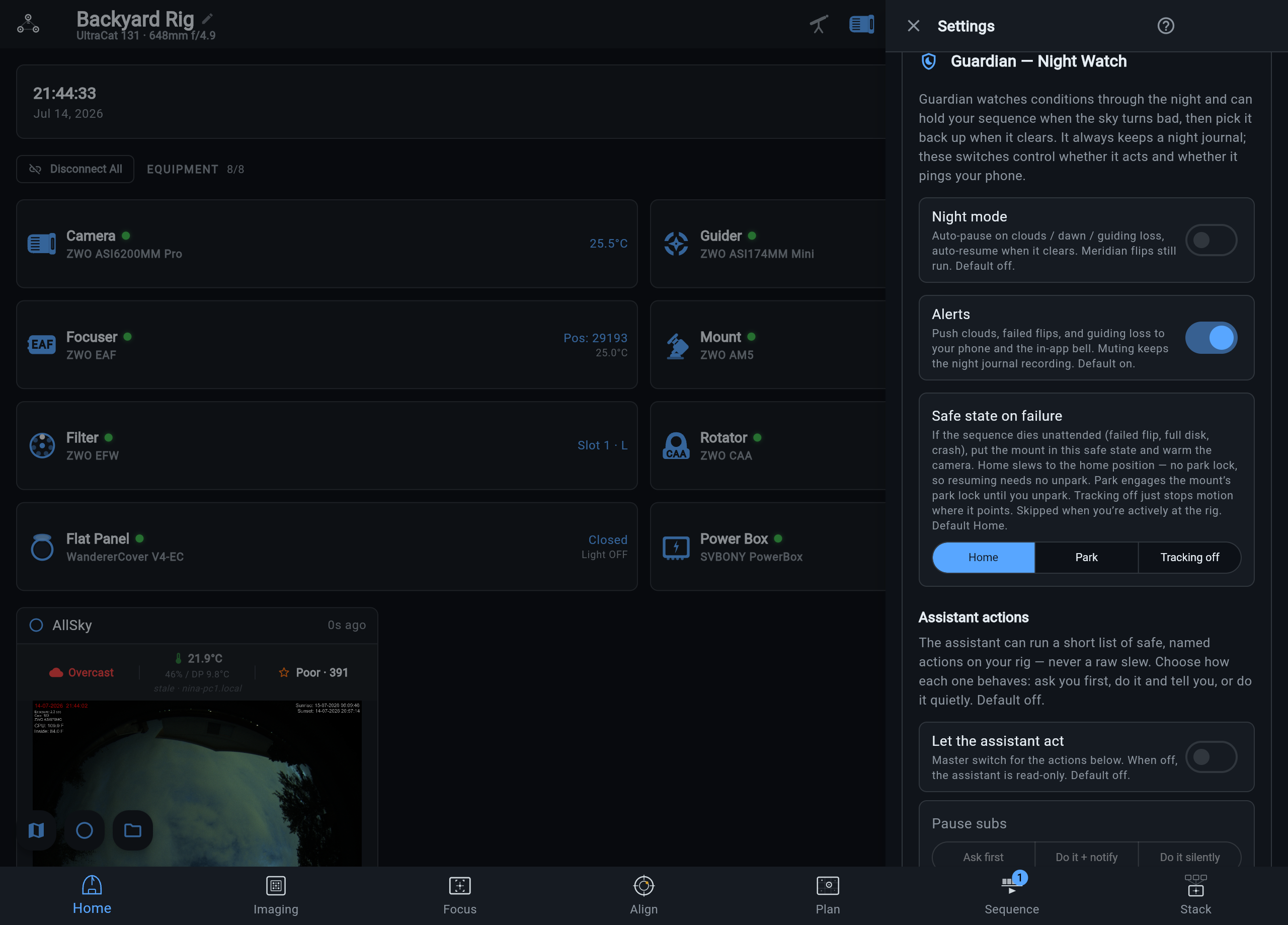
- Night mode — the auto-pause/resume switch. Default off.
- Alerts — the push and in-app notification leg. Muting it silences notifications but never stops the night journal. Default on.
- Safe state on failure — the three-way Home / Park / Tracking off selector. Default Home.
- GUPPI actions — the playbooks master switch, plus a per-playbook autonomy selector. Default off.
Settings persist on the rig itself, so they apply no matter which device you connect from.