ARIS Assistant
Ask your rig a question and get an answer from its live state: “How’s guiding?” — and the answer comes from the guider’s actual RMS right now, not from a canned response or a cloud service. The ARIS Assistant runs on the rig itself, reads the rig’s own telemetry, and answers about what is really happening.
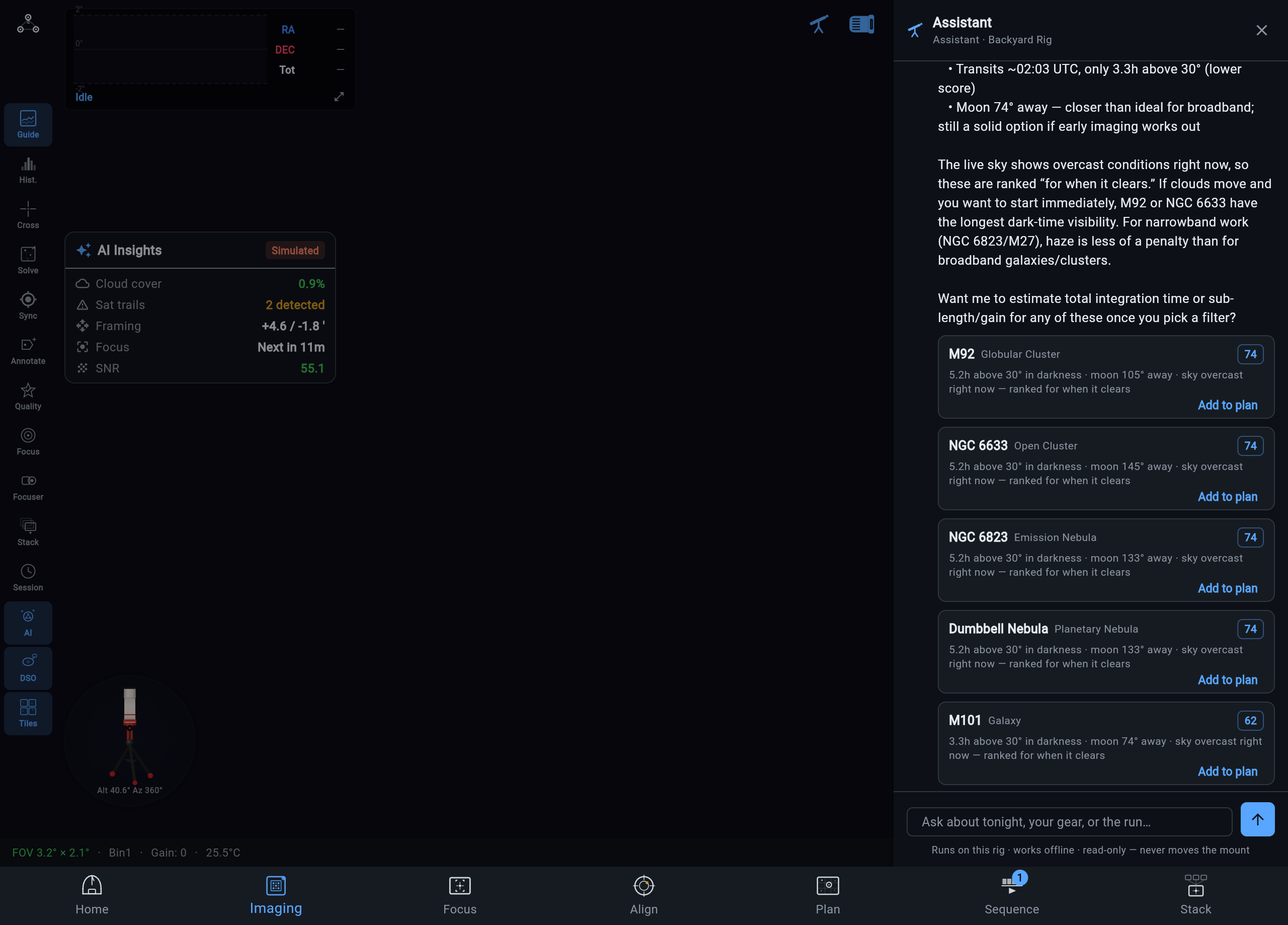
Open it from the telescope glyph in the app header. On desktop it is a side panel; on a phone it is a bottom sheet. The title always reads “Assistant” followed by the rig’s name, because every conversation is grounded in one rig’s live state.
What you can ask
Section titled “What you can ask”The Assistant reads live telemetry through a fixed set of read-only tools:
- Guiding — current RMS, guide star health, and whether that wobble is seeing or something worth fixing.
- Sequence progress — what is running, frames completed, and the ETA.
- Conditions — tonight’s forecast and the golden windows worth imaging (see Weather Intelligence).
- Sky state — what the all-sky camera reads right now, if you have one set up (see All-Sky Camera & Cloud Detection).
- Last night — “What happened last night?” reads the Guardian night journal and gives you the postmortem: what completed, what held, what recovered on its own.
- Targets — “What should I shoot tonight?” returns recommendations scored for your camera, optics, and site — not a generic top-ten list. Each suggestion carries a one-tap Add to Plan that drops the target straight into a Plan draft for review.
Answers show their work. The panel displays which rig tools were consulted for each reply, and when the Assistant explains a concept — what a good RMS looks like, why stars bloat in poor seeing — it cites a curated astrophotography knowledge base rather than improvising.
When it doesn’t have data, it says so. A rig with no forecast source gets an honest “I can’t see a forecast,” not an invented one. And the Assistant only talks astronomy — off-topic questions are declined before they ever reach the model.
Private by construction
Section titled “Private by construction”- The model runs on your rig computer. Your questions, the answers, and every piece of telemetry they touch stay on your network. Nothing is sent to a cloud service, and nothing is used for training.
- It works offline. At a dark site with zero internet, everything grounded in rig state still answers — guiding, sequence, journal, targets. Only internet-backed data such as the weather forecast degrades, and the Assistant tells you when that happens.
- It never touches your images. The Assistant reads telemetry and status, not your data files.
Hardware tiers
Section titled “Hardware tiers”- Full Assistant runs on GPU-accelerated rig computers, which have the headroom to run a language model alongside capture.
- Raspberry Pi rigs get Assistant Light — the same core questions (guiding, sequence status, the night-journal postmortem) answered deterministically, without a language model. Same panel, same honesty, less conversation.
Read-only by design
Section titled “Read-only by design”The Assistant cannot move your mount. It has no slew, park, or capture tools — they do not exist in its toolbox — and the panel states it plainly: read-only, never moves the mount.
The one exception is deliberate, narrow, and opt-in: Guardian playbooks. If you enable them in Settings → Guardian, the Assistant can queue one of a short whitelist of recovery actions — restart the guiding software, re-run autofocus, safe-park the mount. Queuing is all it does: the action itself executes as a deterministic backend command with its own interlocks, exactly as if you had tapped the button yourself. You control each playbook’s autonomy tier — ask first, do and notify, or silent — and the whole capability is off by default.
Availability
Section titled “Availability”The Assistant is a premium feature, included with paid ARIS plans.
It is in early access. Expect it to keep getting smarter — and occasionally to be wrong. The grounding in live telemetry and visible tool calls exists exactly so you can check its work.